 ChatGPT
 Perplexity
 Claude
 Gemini
 Grok
GrokRemote work has moved from pandemic emergency to established working arrangement, but the data on how many people actually work remotely, what they earn, and how productive they are is noisier than the headlines suggest. This post compiles research from Buffer's State of Remote Work reports, the McKinsey Global Institute, Stanford economist Nicholas Bloom's WFH Research, GitLab's all-remote guidance, and Gallup's workplace surveys, and Pew Research Center to give you an honest, sourced picture of where remote work stands in 2026. Every figure below links to its primary source.
Key Statistics at a Glance
| Statistic | Approximate Figure | Source | Year |
|---|---|---|---|
| Paid full workdays worked from home (US) | ~25% (26% across 2025) | Stanford WFH Research (SWAA) | 2026 |
| Pre-pandemic share of paid days worked from home (US) | ~7% | Stanford WFH Research (SWAA) | 2019 |
| Remote-capable US employees working hybrid | 51% | Gallup | Q2 2025 |
| Remote-capable US employees fully remote | ~28% | Gallup | Q2 2025 |
| Remote-capable US employees fully on-site | 21% | Gallup | Q2 2025 |
| Workers who can do their job from home who work remotely at least some of the time | 75% | Pew Research Center | 2025 |
| Remote-capable workers unlikely to stay if remote work were removed | 46% | Pew Research Center | 2025 |
| Advanced-economy workforce that could work from home 3–5 days/week without productivity loss | 20–25% | McKinsey Global Institute | 2021 |
| Remote vs office productivity | Mixed, role-dependent | Stanford / Bloom | 2023 |
How Many People Work Remotely in 2026?
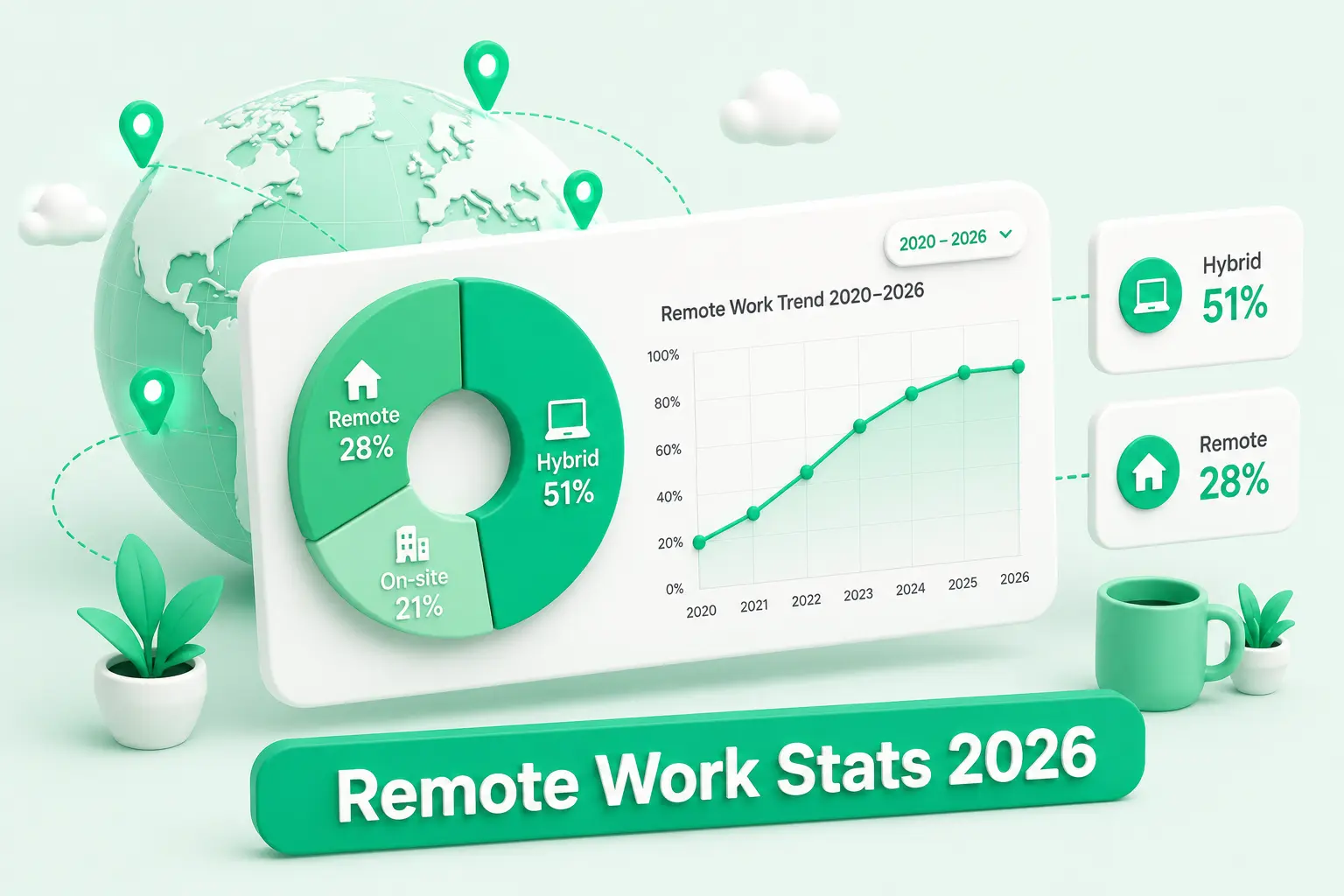
The honest answer is: it depends heavily on how you define "remote work" and which country you are measuring. In the United States, Gallup's workplace surveys have consistently tracked the remote work share since 2020, and the clearest way to read the data is to look only at remote-capable employees: people whose jobs can be done from home at all. Among that group, Gallup's second-quarter 2025 data shows 51% working hybrid, about 28% fully remote, and 21% fully on-site. Hybrid has actually eased down from a peak of 55%, with those points splitting fairly evenly into both fully-remote and fully-on-site work, a sign that arrangements are settling rather than swinging back to the office.
Pew Research Center frames it from the worker's side: in its survey of US adults whose jobs can be done from home, 75% were working remotely at least some of the time, and 46% said they would be unlikely to stay in their job if their employer stopped allowing remote work, including 26% who said they would be very unlikely to stay. Remote work, in other words, has become an expectation rather than a perk for people who can do it.
The McKinsey Global Institute's research on the future of work offers a useful framing: they estimate that roughly 20–25% of workers in advanced economies could work remotely three to five days per week without meaningful productivity loss, a structural ceiling imposed by role type rather than employer preference. Jobs in healthcare delivery, manufacturing, construction, retail, and food service simply cannot be done remotely, which caps the theoretical maximum.
The pandemic-era peak was far higher. At the height of the spring 2020 lockdowns, surveys put the share of US remote-capable employees working from home at roughly 60–70% (Gallup); the exact figure varies with how each survey defines the eligible workforce. Stanford researcher Nicholas Bloom has tracked the rate closely through the Stanford WFH Research project (its Survey of Working Arrangements and Attitudes, whose series is now published on the Federal Reserve's FRED database), and the data shows a decline from that peak that then flattened out rather than collapsing: full work-from-home days accounted for about 26% of paid workdays across 2025 and were running near 25% in early 2026. That is roughly a quarter of all paid US workdays, versus about 7% before the pandemic, a level that has proven remarkably sticky despite years of return-to-office announcements.
Globally, the picture is more fragmented. European workers, particularly in the Netherlands, UK, and Nordic countries, have maintained relatively high hybrid work rates. Workers in East Asian economies, particularly Japan and South Korea, have returned to office at much higher rates due to cultural and managerial norms. Workers in lower-income countries face structural barriers: unreliable internet infrastructure, limited home office space, and employers who have not adopted async workflows.
Which Industries Have the Highest Remote Work Rates?
Technology is the clear leader. Software engineers, product managers, UX designers, data scientists, and technical writers have among the highest rates of full remote work of any professional category. Buffer's 2023 State of Remote Work report found that respondents skewed heavily toward technology and software roles. That is partly a selection effect, since tech workers are most likely to seek out remote work research and communities, but also a reflection of genuine industry concentration.
Financial services (investment analysis, financial planning, accounting, and compliance roles) have seen sustained remote adoption, though investment banks and trading firms have pulled many employees back to office. Marketing and media, including content creation, paid advertising, social media management, and PR, have remained strongly remote-friendly. Legal services (particularly document-heavy roles like contract review, legal research, and compliance) are increasingly remote-compatible.
At the other end of the spectrum, healthcare delivery, manufacturing, construction, retail, and food service have near-zero remote rates for operational roles. Healthcare has seen telemedicine and administrative positions shift remote, but clinical care cannot be virtualized. Manufacturing is similarly bounded by physical presence requirements.
The McKinsey Global Institute estimated that industries like finance, insurance, and technology have the highest share of tasks that can be performed remotely. They also noted that even within "high-remote" industries, only certain roles are genuinely portable: a software company's engineers may be remote-first, while its facilities and operations team cannot be.
What Do Remote Workers Earn Compared to Office Workers?
The salary comparison is more complicated than most headlines suggest. There are two fundamentally different pay models at play, and conflating them produces misleading averages.
Global market rate companies, predominantly US tech firms and startups, pay based on the competitive market rate for the role, regardless of where the employee lives. An engineer hired at global market rate in Lisbon earns the same as one in San Francisco. In this model, remote workers in lower-cost countries have dramatically higher purchasing power than local peers, and often more than in-office counterparts at domestic companies.
Location-adjusted pay companies, including major tech companies like Google, Meta, and many large enterprises, apply a geographic pay multiplier based on the cost of labor market where the employee resides. Moving from San Francisco to Lisbon might reduce your compensation by 30–50% under this model. Research from Stanford's WFH project suggests that location-adjusted pay is the dominant model at large US employers, even those that are otherwise remote-friendly.
On average, remote-capable roles in technology tend to pay above-market relative to the economy broadly, but this reflects skill premiums in tech, not a remote work wage premium per se. Nicholas Bloom's research suggests there is a modest positive wage premium associated with remote-eligible roles, but it is hard to isolate from the underlying industry and skill effects.
Which Countries Have the Most Remote Workers?
In absolute numbers, the United States has the largest remote workforce in the world, driven by the size of its knowledge worker economy and a tech industry that normalized remote work years before COVID. The United Kingdom, particularly London-based knowledge workers, has maintained high hybrid and remote rates post-pandemic, aided by a regulatory environment that supports flexible working requests.
Germany has seen significant remote adoption in its large professional services and technology sectors, though cultural preferences for in-office work and stricter labor regulations have moderated the rate compared to the UK. Canada closely mirrors US patterns, with high remote adoption in tech-concentrated cities like Toronto, Vancouver, and Waterloo.
India is an important and often underreported story. Its technology sector, including major IT services companies, software product companies, and the growing startup ecosystem, employs millions of remote-compatible knowledge workers. Many work for US and European companies either as employees or contractors. India's remote worker population in absolute terms is among the largest in the world, though the share of the overall workforce remains modest given India's economic composition.
Among smaller economies, Portugal, Georgia, Croatia, and Estonia have actively courted remote workers with digital nomad visa programs and infrastructure investments. These countries punch above their population weight in terms of remote worker density per capita.
What Are the Biggest Challenges of Remote Work?
Buffer's State of Remote Work surveys, conducted annually across thousands of remote workers, provide the most consistent long-running data on remote work challenges. Across multiple years, the top challenges have been remarkably stable:
Unplugging from work / overworking. The absence of a physical commute and the blurring of home and office space makes it harder for many remote workers to stop working at the end of the day. Buffer's 2023 data suggests this remains the top challenge, cited by roughly a third of respondents.
Loneliness and isolation. About a quarter of remote workers in Buffer's surveys identify loneliness as a meaningful challenge. This is most acute for solo remote workers without co-working arrangements, and for those who have limited social contact outside of work.
Collaboration and communication. Async communication has a learning curve. Coordinating across time zones, ensuring nothing falls through the cracks without the spontaneous interactions of an office, and maintaining team cohesion are persistent challenges cited in both Buffer's reports and GitLab's Remote Work Report.
Home office setup and distractions. Adequate workspace is not universal. Workers in shared apartments, with children, or in countries with unreliable internet face real productivity constraints that US-centric remote work discourse often ignores.
Career visibility and advancement. Gallup research has noted that remote workers, particularly junior workers early in their careers, can face disadvantages in performance evaluation and promotion relative to in-office peers. This "proximity bias" is an unresolved tension in hybrid and partially-remote organizations.
How Many Remote Job Listings Are Actually Open to Any Country?
This is one of the most practically important statistics for international job seekers, and the answer is discouraging. Despite the proliferation of "remote" job listings on mainstream boards, the majority still carry location restrictions of one kind or another.
At TrulyRemoteWork.com, we review job listings against the actual employer career page before indexing them. Our curation process consistently finds that only a minority of listings that call themselves "remote" are genuinely open to applicants from any country. The specific patterns we see most frequently:
- "Remote, US only": Legal entity, payroll, or equity compliance reasons mean the employer can only hire US residents, despite the role being otherwise location-independent.
- "Remote, must be able to work EST/PST hours": A de facto location restriction that excludes candidates in Asia, Africa, and most of Eastern Europe.
- "Remote, EU preferred": Covers EU residents but excludes most of the rest of the world.
- "Remote, authorized to work in Canada/UK/Australia required": Work authorization requirements exclude the majority of international applicants.
Industry estimates suggest only 20–35% of listings on mainstream job boards that carry the "remote" label are genuinely open to applicants from any country. This is a signal that "remote" has become a marketing label rather than a precise category on most job boards, which is precisely why TrulyRemoteWork.com exists as a dedicated filter for genuinely worldwide roles.
What Does the Data Say About Remote Work Productivity?
The productivity question is the most politically charged in remote work research, and the data is genuinely mixed, which is itself a finding worth taking seriously.
Nicholas Bloom's most cited research, a 2015 randomized controlled trial of call center workers at a Chinese company called Ctrip, found that remote workers were roughly 13% more productive than their office-based counterparts. This study is often cited as proof that remote work improves productivity, but it had important constraints: the workers were doing highly defined, measurable tasks (call handling), and the remote setting was carefully structured.
More recent research has been more nuanced. A widely cited 2022 study of Microsoft employees published in Nature Human Behaviour (Yang et al.) found that company-wide remote work made collaboration networks more siloed and static, which the authors argue could impair the informal information-sharing that drives innovation. Bloom's own summary of the evidence is consistent with this: the productivity impact depends critically on role type. Routine, individual, measurable tasks may benefit from remote settings; complex, collaborative, creative work is where fully remote arrangements are most likely to lag in-person ones.
GitLab's Remote Work Report (worth noting that GitLab has a structural interest in remote work being seen positively, since it is itself fully remote) shows that async teams report high satisfaction and productivity when equipped with good documentation practices and intentional communication structures. GitLab's data shows that remote workers value autonomy, flexibility, and focus time, and rate their own productivity highly. Self-reported productivity is a different metric from independently measured output, however.
The most honest summary of the evidence: remote work does not universally help or hurt productivity. Role type, management quality, home working conditions, and individual working style all moderate the outcome. The strongest case for remote work productivity is in individual contributor roles with clear deliverables; the weakest case is in junior roles requiring mentorship and in high-interdependency creative teams.
What Are the Remote Work Salary Trends by Region?
Salary data for remote workers varies substantially by region, role type, and pay model. The following patterns are consistent across LinkedIn Workforce Reports and Upwork's Future of Work research:
United States (market rate): US-based remote technology workers command the highest salaries globally, with senior software engineers typically earning $130,000–$200,000+ at well-funded tech companies. Remote work has not significantly compressed US tech salaries, as demand for skilled engineers continues to outpace supply.
Western Europe: Remote tech salaries in Germany, Netherlands, and France typically run 30–50% below equivalent US roles at US market rate, but are competitive within European labor markets. Many European employers use local market benchmarks rather than global rates.
Eastern Europe and Latin America: Remote workers contracting for US companies often earn significantly more than local market rates, sometimes 3–5x the local average, while still earning below US market rate for the role. This "middle market" dynamic is a significant driver of the growth in remote work adoption in these regions.
South and Southeast Asia: Remote work salaries for Indian, Filipino, and Southeast Asian workers contracting with Western companies vary enormously. High-skill tech roles (senior engineers, ML engineers, product managers) can command rates close to Western levels at fully remote global companies. Entry-level and support roles are much lower. Upwork's Future of Work data shows Asia-based freelancers have seen among the fastest growth in high-value contracts over recent years.
Sources and Methodology
Every figure on this page is drawn from a named primary source and linked inline. Where we give a range instead of a single number, it reflects genuine differences in methodology. Remote work is measured differently by each research group, and we would rather show the honest spread than a false-precision average. Primary sources used:
Stanford WFH Research (Barrero, Bloom & Davis): the US Survey of Working Arrangements and Attitudes (SWAA), the most consistent tracker of work-from-home days, with its time series now published on the Federal Reserve's FRED database.
Gallup: quarterly US surveys tracking hybrid, fully remote, and on-site shares among remote-capable employees.
Pew Research Center: surveys of US workers whose jobs can be done from home, covering remote uptake and how much workers value it.
McKinsey Global Institute: analysis of more than 2,000 tasks across 800 occupations estimating how much work can be done remotely without productivity loss.
Buffer State of Remote Work (2018–2023): long-running surveys of remote workers on challenges, benefits, and preferences.
GitLab All-Remote: practitioner reporting on async-first team practices from one of the largest fully-remote companies.
Our own data. The one figure only TrulyRemoteWork can report (that roughly 20–35% of listings labelled "remote" on mainstream job boards are genuinely open to applicants from any country) comes from our curation process. Before a job is indexed, we check it against the employer's own careers page and reject anything carrying a hidden US-only, EU-only, timezone, or work-authorization restriction. The share that survives that check is what informs the 20–35% range. Journalists and researchers are welcome to cite this page as the source; if you need the underlying breakdown for a story, reach out and we will share it.
Want to act on the data? Browse every genuinely worldwide-remote role we've verified, dig into pay by field in our remote salary guide, or start with how to get a remote job from anywhere in the world.